
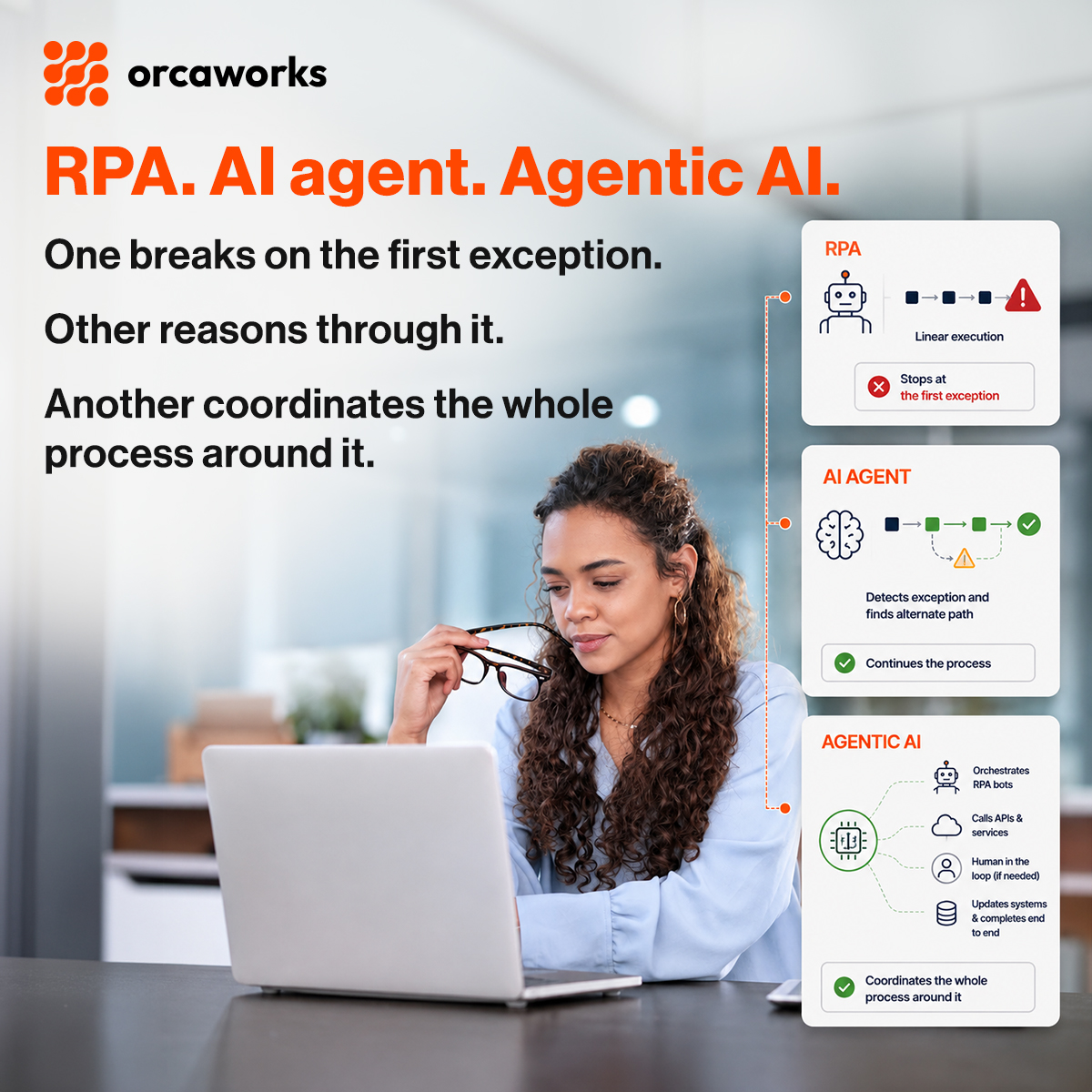
Understanding agentic AI vs AI agents, and where RPA fits alongside both, starts with a much narrower question than most vendor decks ask: does this system follow a fixed rule, respond to one task using judgment, or coordinate multiple steps toward a goal on its own? For a deeper look at what a fully governed platform built around that last category looks like, our breakdown of what an agentic AI platform really is worth reading alongside this comparison.
The three categories aren’t competing versions of the same idea. They solve different problems, carry different risks, and require very different levels of oversight once they’re running in production rather than sitting in a demo.
What Is RPA, and Where Does It Still Fit Today
RPA automates repetitive digital tasks by executing a fixed, pre-programmed sequence of steps, typically mimicking clicks, keystrokes, and data entry across a user interface. It has no capacity to interpret meaning. It simply executes exactly what it was scripted to do, every time, in the same order.
How RPA Executes Work
A typical RPA bot logs into a system, copies data from one field, pastes it into another, and moves to the next record. The logic is entirely rule-based: if the screen looks exactly as expected, the bot proceeds; if anything is different, it stops or fails silently.
Why RPA Still Has a Place in Enterprise Automation
For high-volume, perfectly structured, rarely changing processes, RPA remains genuinely useful. Reconciling two systems that never change their data format, or moving a known field from one form to another thousands of times a day, is exactly the kind of work RPA was built for, and it does that work fast and cheaply.
Where RPA Breaks Down
The moment a process involves any variation, a slightly different invoice layout, a field that’s sometimes missing, a decision that depends on context, RPA has no way to adapt. Every new variation typically requires a developer to write a new rule or exception path, which is why RPA deployments tend to multiply into hundreds of narrow, brittle bots that become expensive to maintain and difficult to debug once something in the underlying system changes.
Agentic AI vs AI Agents: What’s the Difference
Agentic AI vs AI agents come down to scope and coordination, not raw capability. An AI agent is built to handle one bounded task using reasoning and context. Agentic AI coordinates multiple agents, tools, and decision points toward a broader outcome, adjusting its approach as conditions change along the way.
What a Single AI Agent Does
A single AI agent reads a document, an email, a support ticket, and reasons over its meaning before producing a result. It might extract structured data from an unstructured contract, draft a response grounded in company policy, or flag an anomaly a rule-based system would miss entirely. Its scope is narrow by design: one task, handled with judgment RPA simply doesn’t have.
What Makes AI Agents Automation Different from Scripted Automation
AI agents automation differs from scripted automation in exactly the place RPA fails: interpretation. A script executes the same instruction regardless of what it encounters. An AI agent evaluates what it’s looking at, decides what matters, and adjusts its output accordingly, without needing a developer to hand-code every possible variation in advance.
What Agentic AI Adds on Top of an Agent
Agentic AI takes that same reasoning capability and applies it across a sequence of steps rather than a single one. Instead of handing back one result, it pursues an outcome: checking whether a step succeeded, deciding what to do next, involving a different specialized agent where needed, and adjusting its plan when something doesn’t go as expected.
One Agent vs an Agentic Workflow: What That Looks Like in Practice
A single AI agent might read an incoming RFP and extract the submission requirements accurately and quickly. An agentic workflow takes that extraction and keeps going: checking the requirements against past submissions for compliance gaps, routing sections to the right internal reviewers, flagging inconsistencies for a human to confirm, and assembling a draft response, all without a person manually triggering each handoff. The agent does one thing well. The agentic system owns the outcome.
AI Agent vs RPA: A Closer Look at the Differences
The AI agent vs RPA comparison ultimately comes down to how each one handles the unexpected. RPA has no mechanism for handling anything it wasn’t explicitly scripted for. An AI agent is built specifically to handle variation using reasoning rather than rigid rules.
Structured vs Unstructured Input
RPA needs clean, consistent, structured data to function reliably. An AI agent can work directly with unstructured input, a scanned PDF, a free-form email, a handwritten note, interpreting meaning rather than requiring a predictable format.
Fixed Logic vs Reasoning
RPA logic is entirely deterministic: the same input always produces the same output, following the exact steps it was given. An AI agent reasons contextually, which means its output can (and should) vary depending on the specifics of what it’s reviewing, the same way a knowledgeable employee would respond differently to two superficially similar requests with different underlying context.
Failure Modes: How Each One Breaks
RPA fails hard and visibly: a changed screen layout or field name typically stops the bot outright, which at least makes the failure obvious. AI agents fail more quietly, they might produce a plausible-sounding but incorrect answer if given ambiguous or misleading context, which is exactly why oversight and validation matter more with reasoning-based systems than with scripted ones, not less.
Agentic Process Automation vs RPA: Where the Operational Gap Shows Up Most
Agentic process automation vs RPA is less a question of speed and more a question of what kind of work each one can safely be trusted with. RPA suits stable, rule-based processes with no meaningful variation. Agentic process automation is built for processes where judgment, exceptions, and shifting context are the norm, while still enforcing the governance controls a regulated process requires.
Exception Handling
In an RPA deployment, an exception usually means the bot stops and a human has to intervene manually, often without much context about what went wrong. In an agentic process automation deployment, the exception itself becomes something the system can reason about, flagging it with context, suggesting a resolution, or routing it to the right reviewer automatically.
Governance and Audit Requirements
RPA’s audit trail is simple because its behavior is simple: a log of steps executed. Agentic process automation requires a meaningfully different governance layer, since decisions, not just actions, need to be traceable. Orcaworks’ agentic process automation approach builds that traceability directly into how each workflow runs, so every decision an agent makes ties back to an approved, auditable rule rather than an opaque judgment call.
A Real Workflow Comparison
Consider contract review across all three models. Under RPA, a bot might extract specific fields from contracts that always follow the same template, and nothing else. Under a single AI agent, a reviewer gets a summary of key terms and flagged risks in one contract at a time, still requiring a human to manage the review process itself. Under agentic process automation, the system routes each contract based on its risk profile, checks it against a policy library, escalates specific clauses to legal automatically, and maintains a full audit trail of why each routing decision was made, without a human manually managing every step.
Comparing RPA, AI Agents, and Agentic AI
| Dimension | RPA | AI Agents | Agentic AI |
|---|---|---|---|
| Input type | Structured data only | Structured and unstructured | Structured and unstructured, across multiple sources |
| Decision logic | Fixed, rule-based | Contextual reasoning, single task | Contextual reasoning, sequenced across steps |
| Adaptability | None, breaks on change | Adapts within task scope | Adjusts plan as conditions shift |
| Governance needs | Low, execution logs only | Moderate, task-level review | High, full decision traceability |
| Maintenance burden | High as exceptions multiply | Moderate, tied to task scope | Built-in, if governed at the platform level |
| Typical failure mode | Hard failure, visible and immediate | Plausible but incorrect output | Compounding errors across steps if ungoverned |
| Best-fit use case | Stable, repetitive, high-volume tasks | Single, judgment-heavy tasks | Complex, multi-step processes needing coordination |
Agentic AI Workflows vs Agents: Single Task vs Orchestrated Outcome
Agentic AI workflows vs agents is fundamentally a question of scale rather than capability. One agent handling one task well is still just an AI agent. Multiple agents coordinating across a full process, with checkpoints, handoffs, and governance built in, is what makes something an agentic AI workflow.
When One Agent Is the Right Scope
Not every use case benefits from orchestration. Extracting data from a form, summarizing a document, or answering a well-defined question are all served well by a single, narrowly scoped agent. Layering orchestration on top of a task this simple adds cost and complexity without adding meaningful value.
When a Process Needs Full Orchestration
The calculus changes once a process spans multiple interdependent steps with real consequences attached: reviewing a bid response end to end, validating compliance across an entire contract lifecycle, or coordinating handoffs between departments that each need different context. These are the scenarios where a single agent’s narrow scope becomes a limitation, and where the kind of production-grade orchestration covered in Orcaworks’ blueprint for building production-grade AI agents becomes necessary rather than optional.
How to Decide Which Model Fits Your Process
Deciding between RPA, an AI agent, and a full agentic AI workflow starts with the same agentic AI vs AI agents question this entire comparison is built around, and gets more specific from there.
1. Does the process involve unstructured or unpredictable input?
If every input is clean and structured, RPA remains the simplest, most cost-effective choice. If input varies in format or requires interpretation, an AI agent or agentic AI is the better fit.
2. Is this a single, bounded task, or a sequence of interdependent steps?
A well-defined, standalone task usually needs only one AI agent. A multi-step process with real dependencies between stages needs agentic AI to coordinate them properly.
3. What happens when something goes wrong mid-process?
If an exception simply needs a human to step in and handle it manually, a single agent or RPA can work. If the exception itself needs to be reasoned about, routed, and resolved as part of the process, that points toward agentic orchestration.
4. How much governance and audit visibility does this process require?
Low-stakes, repetitive tasks can run with lighter oversight. High-stakes processes touching compliance, finance, or client commitments need the policy enforcement and full audit trail that a governed agentic AI platform provides by design, not as an add-on.
Why Getting This Distinction Right Matters More in Production
The gap between RPA, AI agents, and agentic AI becomes far more consequential once a system moves from a pilot into daily production use, where the cost of choosing the wrong category shows up as either wasted capability or unmanaged risk. A brittle RPA bot fails loudly. An ungoverned AI agent fails quietly, producing a plausible but wrong answer nobody catches until it’s already caused a problem. Agentic AI without governance compounds that risk further, since one flawed decision can ripple across every step that follows it.
This is exactly the gap Orcaworks is built to close. Rather than treating governance as something bolted onto an agent after the fact, Orcaworks builds policy enforcement, approval routing, and full decision traceability directly into how agentic workflows run, so enterprises get the coordination benefits of agentic AI without losing the audit trail a regulated process demands. Every action an agent takes ties back to an approved rule, which means teams can move complex, judgment-heavy processes into production with confidence, not just a hope that nothing goes wrong.
Enterprises that treat RPA, AI agents, and agentic AI as interchangeable tend to make one of two mistakes: over-engineering a simple task with unnecessary orchestration, or under-governing a complex one that needed it from the start. Getting the agentic AI vs AI agents distinction right, and knowing exactly where RPA still belongs, is the first real decision point in building something that runs reliably in production instead of stalling out as another pilot nobody trusts enough to scale.
Frequently Asked Questions
1.What is the difference betweenagenticAI vs AI agents?
An AI agent handles one bounded task using reasoning and context, like extracting data from a document or drafting a response. Agentic AI coordinates multiple agents, tools, and decision points toward a broader outcome, adjusting its approach across a sequence of steps rather than producing a single result.
2. What is RPA, and how is it different from AI agents?
RPA executes a fixed, pre-programmed sequence of steps, mimickingclicks and data entry across a user interface with no ability to interpret meaning. AI agents reason over unstructured input and adapt their output based on context, which is exactly the capability RPA lacks.
3. Is RPA still useful now that AI agents and agentic AI exist?
Yes. RPAremains a strong fit for stable, repetitive, high-volume tasks involving structured data that rarely changes. It’s fast and cost-effective for that narrow use case, even though it can’t handle variation or judgment the way an AI agent can.
4. What does AI agent vs RPAcomedown to in practice?
It comes down to how each one handles the unexpected. RPA fails or stops the moment conditions differ from what it was scripted for. An AI agent reasons through variation and unstructured input, adapting its response rather than breaking outright.
5. What is agentic process automation, and how is it different from RPA?
Agentic process automation applies reasoning and governed decision-making to processes with exceptions, judgment calls, and shifting context, things RPA cannot handle. RPA suits stable, rule-based processes, while agentic process automation is built for processes where variation is the norm.
6. What’s the difference between AIagentsautomation and a traditional automation script?
A traditional script executes the same instruction regardless of what it encounters. AI agents automation evaluates what it’s looking at and adjusts its output accordingly, using reasoning instead of requiring every possible variation to be hand-coded in advance.
7. When should a business use a single AI agent instead of a full agentic AI workflow?
A single AI agent is the right fit for well-defined, standalone tasks like summarizing a document or extracting data from a form. Agentic AI workflows become necessary once a process involves multiple interdependent steps with real consequences attached.
8. How does governance differ between RPA, AI agents, and agentic AI?
RPArequires minimal governance since its logic is fixed and its audit trail is simple execution logs. AI agents need task-level oversight. Agentic AI requires full decision traceability, since it’s making sequenced decisions across a process, not just executing predefined steps.
9. How do I decide which model, RPA, an AI agent, or agentic AI, fits my process?
It depends on the input type, whether the process is a single task or a multi-step sequence, how exceptions need to be handled, and how much governance and audit visibility the process requires.High-stakes, judgment-heavy, multi-step processes generally need agentic AI.
10. What happens if a business chooses the wrong model for a given process?
Choosing RPA for a process that needs judgment leads to a system that breaks constantly. Choosing agentic AI for a simple, stable task adds unnecessary cost and complexity. Getting the category right from the start avoids both outcomes.