
Building Safe AI Systems
Why This Handbook Exists
Enterprise AI is no longer just helping people work. It is starting to participate directly in how systems operate. Across support, operations, legal, and finance, models are being embedded into workflows that read context, make decisions, and increasingly take actions across other systems.
This handbook is about how to build those systems safely. Not from a policy-first perspective, and not as a discussion about model capability. This is a handbook about system design — how to reason about control, where that control must live, and how to keep it explicit as capability increases in modern Enterprise AI Solutions.
This is not a handbook about what AI can do. It is about what an AI system is allowed to do.
We Are Embedding Stochastic Systems Into Deterministic Software
Traditional enterprise software is built around explicit control. Behavior is defined ahead of time through code, workflows, and configuration. If something goes wrong, you trace the logic and fix it. That model works because the system is deterministic. AI systems introduce something fundamentally different, especially as organizations adopt AI Security Solutions and AI Compliance Solutions alongside deployment.
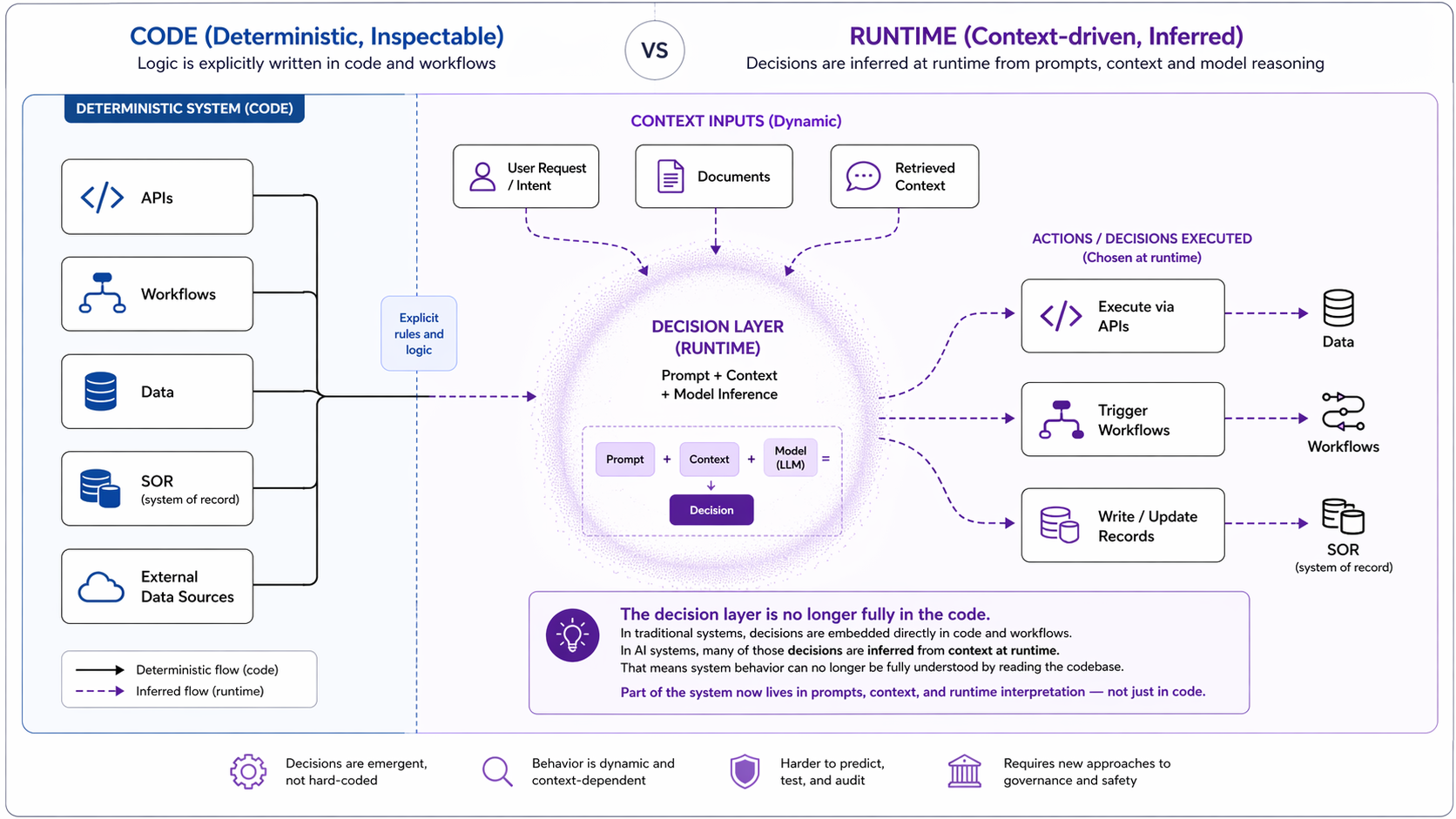
They place a probabilistic decision layer inside the execution path.
This layer interprets context, decides what matters, selects tools, and proposes or initiates actions at runtime. One way to think about these models — borrowing from the “stochastic parrots” framing — is that they generate behavior based on learned statistical patterns, not explicit logic encoded in code. That does not make them unreliable. It makes them powerful and unpredictable in specific ways.
The critical shift is this: We are taking systems that generate probabilistic outputs — and giving them the ability to drive deterministic actions.
The decision layer is no longer fully in the code
In traditional systems, decisions are embedded directly in code and workflows. In AI systems, many of those decisions are inferred from context at runtime. That means system behavior can no longer be fully understood by reading the codebase.
Part of the system now lives in prompts, context, and runtime interpretation — not just in code.
Safe AI is a Control Problem
Most teams start by focusing on capability.
- Can the system answer better?
- Can it automate more of the workflow?
- Can it interact with more tools?
Those are useful questions.
But they are not the main ones.
Once a system can select tools, trigger workflows, and act across systems, the central question is no longer capability — it is authority, scope, and execution.
This is where traditional assumptions start to break.
Authorization is no longer a simple mapping from user to application to resource. Control flow is no longer fully encoded in code. System boundaries blur as context and tool access span across systems. Even the “model” is no longer a single artifact, but a combination of prompts, context, orchestration, and tools that together shape behavior.
These are not edge cases. They are the default operating conditions, and this is where AI Governance Solutions and Responsible AI Solutions become critical.
The Principle
Safe AI starts with a simple principle:
once a system can decide and act at runtime, control cannot live only in the codebase.
If a system can interpret context, choose actions, and execute them across systems, then control must exist outside the code itself.
It must be explicit in:
- what context the system can use
- what decisions it is allowed to make
- what actions it is allowed to take
- under whose authority those actions occur
- how that behavior is made visible and traceable
If you cannot answer these clearly, you do not have a controlled system, regardless of how advanced your Enterprise AI Governance Solutions or Enterprise AI Security Solutions may be.
What Comes Next
Part I focuses on understanding the system you are building — the risks that emerge when context, decision-making, and action are combined, and what to look for when evaluating these systems.
From there, we build a practical model for designing safe AI systems in the enterprise, aligned with emerging AI Compliance Solutions and governance frameworks. Because the problem is not getting AI to work. It is making sure it behaves within the boundaries you actually intend.
Appendix — Further Reading
For readers who want to go deeper after this introduction, these are the five references I would start with. Together, they reinforce the core argument of this chapter: safe AI is not just a model problem or a governance problem — it is a systems control problem.
1. NIST Generative AI Profile
A strong bridge from traditional AI governance into modern generative AI. It extends the NIST AI Risk Management Framework with generative-AI-specific risks and suggested actions.
Why it matters:
It helps frame the move from general governance language to practical concerns like hallucination, misuse, monitoring, provenance, and incident handling.
🔗 https://nvlpubs.nist.gov/nistpubs/ai/NIST.AI.600-1.pdf
2. Agentic AI Identity and Access Management
A strong reference for thinking about AI agents as security principals in their own right, with explicit credentials, permissions, and boundaries.
Why it matters:
It supports the argument that traditional IAM and AAA models do not map cleanly onto agentic systems, especially once they become dynamic and semi-autonomous.
🔗 https://arxiv.org/pdf/2505.19301
3. Authenticated Delegation and Authorized AI Agents
A practical foundation for “act on behalf of” patterns in enterprise systems, with a focus on delegated authority, permission scoping, and auditability.
Why it matters:
It sharpens the distinction between user intent, delegated authority, and agent execution — which becomes critical once systems start acting across multiple tools and services.
🔗 https://arxiv.org/abs/2501.09674
4. Securing the Model Context Protocol (MCP)
A useful paper for understanding that context exchange and tool integration are not just implementation details — they are part of the system’s attack surface and control surface.
Why it matters:
It reinforces the idea that context is not just input. It is part of the boundary that must be controlled when models can access tools and external systems dynamically.
🔗 https://arxiv.org/abs/2511.20920
5. Trustworthy AI Posture (TAIP)
A strong reference on continuous assurance for agentic systems, moving beyond one-time reviews toward ongoing operational trust.
Why it matters:
It supports the principle that once systems can decide and act at runtime, trust and control must also be established and measured at runtime.
🔗 https://arxiv.org/abs/2603.03340
The Emerging Risk Landscape