
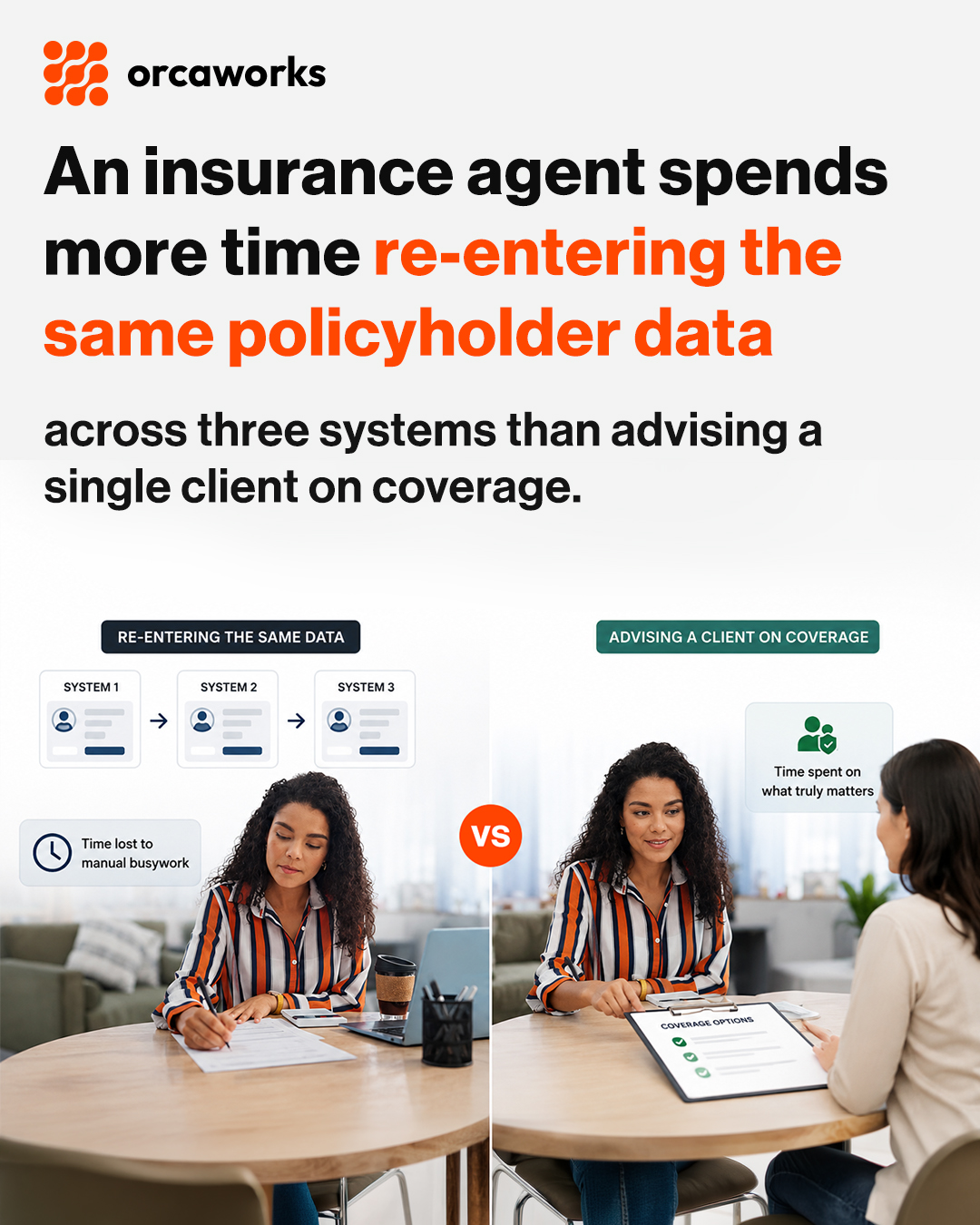
For insurance agents and carrier operations teams evaluating this space, the distinction between automation that merely moves data and automation that understands it matters more than any single vendor feature list.
What Insurance Automation Software Looks Like on an Agentic AI Platform
Insurance automation software spans a real spectrum, from simple scripted bots that move data between two systems to AI-driven platforms that read unstructured claims documents, coordinate multi-step workflows, and route decisions with a full audit trail. Understanding where a given tool sits on that spectrum matters more than any individual feature, because the two ends solve fundamentally different problems.
| Approach | How It Operates | Handles Exceptions | Best Fit in Insurance |
|---|---|---|---|
| Manual Processing | Performed entirely by agents, adjusters, or service reps | Fully, by human judgment | Complex, low-volume work requiring nuanced judgment |
| Robotic Process Automation (RPA) | Scripted, rule-based steps mimicking clicks and data entry | Poorly, breaks on format changes | Stable, high-volume, structured data tasks |
| Agentic AI Automation | Reasons over unstructured input, coordinates multi-agent workflows | Well, with governance and audit trails built in | Judgment-heavy busywork at scale, with compliance needs |
This table is the foundation for everything that follows, because most software marketed as “insurance automation” today still falls squarely into the middle row, regardless of how it’s positioned in a sales conversation.
Robotic Process Automation in Insurance: A Quick Recap
Robotic process automation in insurance became widespread because so much of the industry’s core administrative work, moving policy data between systems, populating standard forms, checking box-level compliance rules, was structured and repetitive enough for a script to handle reliably. RPA bots delivered real time savings for carriers running decades-old policy administration systems, and for a long time, that was considered a genuine modernization win.
The appeal made sense on paper: fast implementation, low cost per bot, and immediate relief from tasks nobody wanted to do by hand. Agents and back-office staff got some of their time back, at least for the narrow slice of work that fit neatly into a rule-based script.
Where RPA in Insurance Runs Out of Road
RPA in insurance hits a wall the moment a task requires interpretation rather than pure data movement. A claims document that arrives as a scanned PDF instead of a structured form breaks a script built to read specific fields in specific locations. A policy exception that doesn’t match any pre-programmed rule either halts the process entirely, or worse, gets processed incorrectly with nobody noticing until much later.
This is exactly why so many carriers end up maintaining dozens of narrow, brittle bots instead of one coherent automation layer. Every new document format, every regulatory change, every product line variation requires a developer to write a new rule, and the maintenance burden eventually outpaces whatever time the automation originally saved. Insurance agents on the front line feel this most directly: the busywork RPA was supposed to eliminate often just shifts into a new form, manually fixing what the bot got wrong.
Why Insurance Process Automation Needs to Be Agentic, Not Just Automated
Insurance process automation built on scripted logic alone was never going to close the gap between what agents deal with day to day and what a rule-based system can reliably process. Real insurance work is full of ambiguity: a claims narrative that doesn’t fit a template, a policy submission missing a field nobody flagged, a customer request that touches three different systems at once.
McKinsey has projected that automated underwriting could eventually handle the large majority of individual and small-business policy decisions, a shift that depends entirely on systems capable of reasoning over unstructured submissions rather than simply executing fixed rules. That’s the practical argument for agentic AI over traditional automation: the work insurance agents spend their time on was rarely the kind of clean, structured task RPA was built to handle in the first place.
“Insurance is one of the clearest examples of an industry where the busywork isn’t simple,” says Dr. Abhinav Somaraju, co-founder of Orcaworks. “A claims intake form looks routine until you realize every submission is slightly different, and that’s exactly the kind of variation agentic systems are built to handle, not paper over.”
Where Agentic Workflows Replace Manual Busywork for Insurance Agents
Insurance automation software built on an agentic foundation shows its value most clearly in the specific, document-heavy workflows where insurance agents currently lose the most time to repetitive, low-judgment tasks.
Claims Intake and Document-Heavy Processing
Claims intake is one of the most document-intensive touchpoints in the entire insurance workflow, arriving as scanned forms, emailed photos, medical records, and free-form policyholder descriptions that rarely follow a consistent structure. An agentic system can extract the relevant details from that unstructured input, flag missing information immediately, and route the claim to the right queue without an agent manually reading through every submission first. Orcaworks’ approach to document-driven operations is built specifically around this kind of high-volume, unstructured document work.
The practical effect shows up immediately in how much of an agent’s day gets freed up. Claims that used to require manual sorting and data entry now arrive pre-processed, with an agent’s attention reserved for genuine exceptions rather than routine intake.
Fraud Pattern Detection Across Claims
Fraud detection depends on spotting patterns across large volumes of claims data, something a rule-based system can only do within the narrow patterns it was explicitly programmed to catch. An agentic system can reason across a broader set of signals, flagging suspicious combinations that wouldn’t trigger a simple rule but that an experienced investigator would recognize as worth a closer look. Orcaworks’ agentic process automation applies this reasoning capability directly to fraud workflows, coordinating detection and escalation as part of a governed, auditable process rather than a standalone scoring model.
Property Claims and Field Inspection Verification
Property and casualty claims often require verifying field inspection reports against submitted damage estimates, a task that involves cross-referencing photos, adjuster notes, and policy terms that rarely align perfectly. Orcaworks’ work in facilities management adapts naturally to this exact problem, using agentic reasoning to cross-check inspection data against claims documentation and flag discrepancies for a human reviewer, rather than requiring an agent to manually reconcile every detail by hand.
Inside Orcaworks’ Approach to Insurance Automation Software
Insurance automation software built the wrong way creates a specific, recurring problem: it works well enough in a demo, then breaks down the moment real data, real exceptions, and real compliance requirements enter the picture. Orcaworks’ architecture is built specifically to avoid that failure mode, using the same four-layer structure across every industry it serves, including insurance.
- Orca Studio is where insurance-specific rules and business context get defined and reviewed before anything runs live, so a compliance team can sign off on exactly how a claims or underwriting workflow will behave before it touches real policyholder data.
- Orca Registry stores that logic as versioned, auditable artifacts rather than burying it inside a prompt that shifts unpredictably across runs.
- Orca Lattice executes that logic in real time, routing anything requiring human judgment, a flagged fraud pattern, an ambiguous claim, to the right person automatically rather than depending on the system to remember to ask.
- Orca Launchpod brings in the people, Flow Architects and Context Engineers, who translate a carrier’s actual claims and underwriting processes into that governed logic and keep refining it after deployment.
This architecture is exactly what separates governed agentic automation from the RPA scripts insurance agents have grown used to working around. Our detailed comparison of agentic AI vs AI agents vs RPA goes deeper into why that distinction matters operationally, not just conceptually, and our look at why enterprise AI failures are so hard to debug explains exactly the kind of silent failure mode this architecture is built to prevent.
A Framework for Insurance Teams Evaluating Agentic Automation Software
Choosing the right insurance automation software comes down to four questions that separate a governed, scalable deployment from another brittle bot layered on top of a legacy system.
Does it handle unstructured documents, or only clean, structured data?
If a platform requires every input in a fixed format, it’s still operating in RPA territory regardless of how it’s marketed. Claims and underwriting work is rarely that clean, and genuine insurance process automation needs to handle scanned forms, free-form narratives, and inconsistent formats without breaking.
Can every automated decision be explained after the fact?
Insurance regulators can and do require carriers to justify specific claims or underwriting decisions. Automation without a full, reconstructable audit trail creates real regulatory exposure the moment that question comes up, regardless of how sophisticated the underlying model is.
Does it reduce the manual busywork agents are dealing with, or just shift it elsewhere?
Automation that requires an agent to constantly review and correct its output hasn’t removed the busywork, it’s just relocated it. The right platform should be measurably reducing the repetitive tasks agents spend their time on, not creating a new category of oversight work.
Is there a clear path to scaling past the first workflow?
A platform that solves one narrow use case well but has no path to a second or third tends to stall as another isolated pilot, rather than becoming the automation layer a carrier can build on for years.
Getting Started With Agentic AI for Insurance Operations
Insurance automation software isn’t about replacing agents, adjusters, or underwriters. It’s about removing the repetitive, document-heavy busywork that keeps skilled people from spending their time on the judgment calls that require their expertise, advising a client, investigating a genuinely ambiguous claim, evaluating a complex risk.
The carriers and agencies seeing the clearest results aren’t automating everything at once. They’re identifying the highest-volume, most document-heavy workflows, claims intake, fraud pattern detection, field inspection verification, and building governed automation around those first, before expanding further. Orcaworks’ agentic platform is built around exactly that principle: start with a defined, high-value workflow, prove the impact with full auditability intact, and scale from there without ever trading governance for speed.
Frequently Asked Questions
1. What is insurance automation software?
Insurance automation software covers a range of tools, from simple rule-based bots to AI-driven platforms, that automate insurance processes like claims intake, fraud detection, and policy servicing. The more advanced end of that range can read unstructured documents and reason over context, rather than just executing fixed scripts.
2. What is robotic process automation in insurance used for?
Robotic process automation in insurance is typically used for structured, repetitive tasks like moving policy data between systems and populating standard forms. It works reliably as long as inputs stay consistent, but it has no ability to interpret variation or ambiguity.
3. What’s the difference between RPA in insurance and agentic AI automation?
RPA in insurance follows fixed, scripted rules and breaks when it encounters unstructured or inconsistent input. Agentic AI reasons over context, coordinating multi-step workflows and handling exceptions that a script was never built to interpret.
4. How does agentic AI reduce manual busywork for insurance agents?
Agentic AI extracts relevant details from unstructured claims documents, flags missing information automatically, and routes work to the right queue without an agent manually reviewing every submission first. This shifts an agent’s time away from repetitive data entry and toward genuine judgment calls.
5. Can agentic AI help with insurance fraud detection?
Yes. Agentic systems can reason across a broader set of claims signals than a rule-based fraud model, flagging suspicious combinations that wouldn’t trigger a simple rule but that an experienced investigator would recognize as worth investigating further.
6. Is insurance process automation only useful for large carriers?
No. While large carriers often process the highest volumes, smaller agencies and carriers see similar percentage gains in time saved on claims intake and policy servicing, where document volume is high relative to team size.
7. How does agentic automation handle compliance and audit requirements in insurance?
A well-built platform ties every automated decision back to an approved, versioned rule, creating a full audit trail that can be reconstructed later. This matters specifically in insurance, where regulators can require carriers to explain how a claims or underwriting decision was reached.
8. What should insurance teams look for when evaluating automation software?
Key criteria include whether it handles unstructured documents rather than just clean data, whether every decision can be explained after the fact, whether it genuinely reduces busywork rather than just relocating it, and whether there’s a clear path to scaling to additional workflows.
9. Does agentic AI replace insurance agents and adjusters?
No. It removes the repetitive, document-heavy bottlenecks, intake sorting, data gathering, routine verification, so agents and adjusters can focus on the judgment calls and client relationships that require their expertise.
10. How should an insurance agency get started with agentic automation?
Start with one high-volume, document-heavy workflow rather than automating everything at once. Prove measurable impact with full auditability built in from the start, then expand to additional workflows like fraud detection or field inspection once that first deployment is validated.