
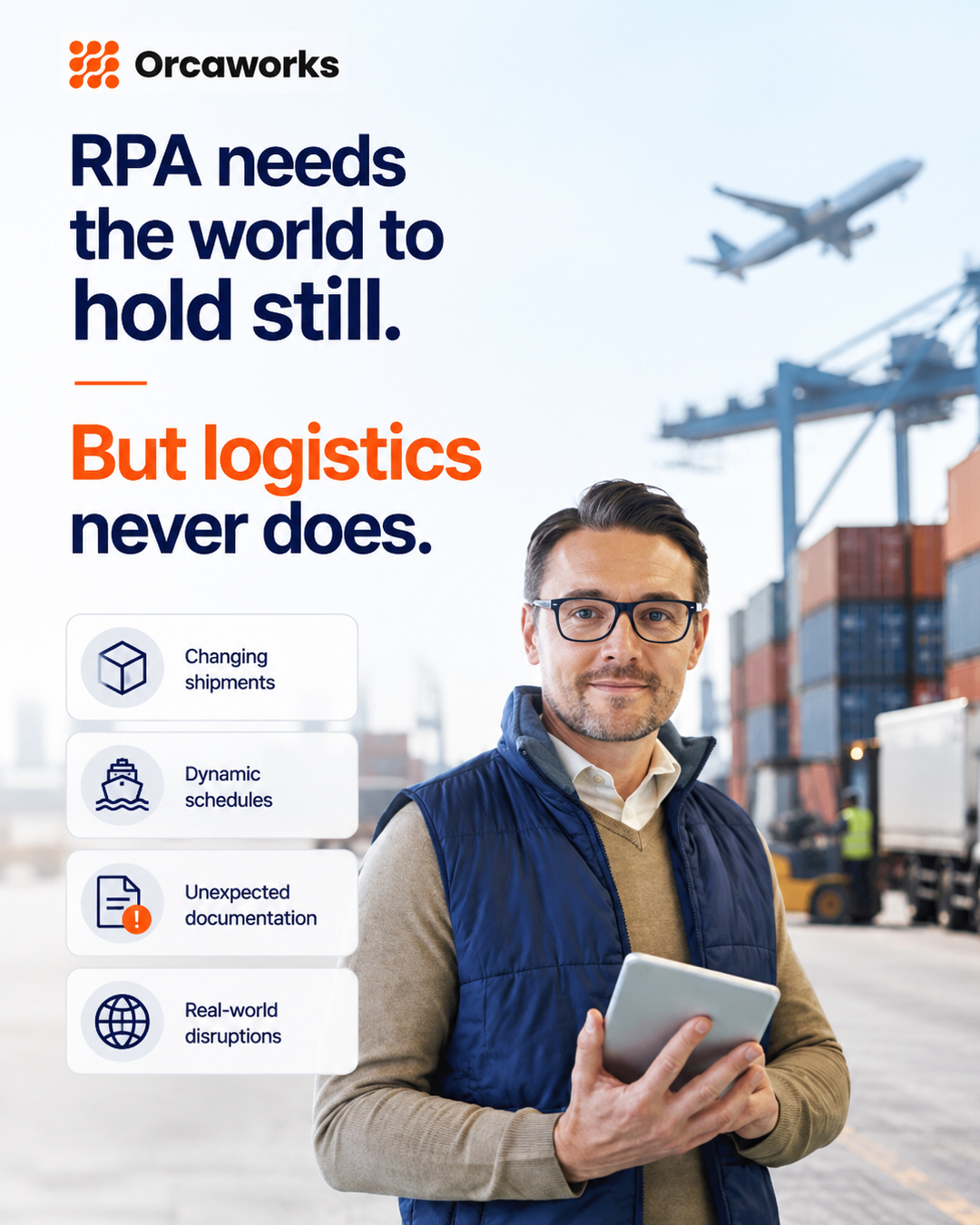
This isn’t a marginal upgrade to existing tools. It’s a genuinely different approach to how logistics and transportation operations get automated, and understanding the difference matters before committing budget to either path.
Why Supply Chain Automation Companies Are Hitting an RPA Ceiling
RPA earned its place in logistics for good reason, and it still has one, but the ceiling it runs into isn’t a minor inconvenience anymore as volume and complexity both keep climbing.
What RPA Solved Well in Logistics
RPA bots became standard across freight and transportation operations because so much of the industry’s core work, moving data between systems, populating standard forms, checking compliance fields, was structured and repetitive enough for a script to handle reliably. For a logistics company running on decades-old warehouse and transportation management systems, RPA delivered fast, low-cost relief from tasks nobody wanted to do by hand. A bot that moves shipment data from a booking system into a billing system doesn’t need to understand what a shipment is. It just needs the two systems to stay consistent, which, for a long stretch of the industry’s recent history, they mostly did.
Why That Approach Worked for as Long as It Did
Logistics operations scaled for years on the assumption that document formats, system integrations, and process steps would stay relatively stable once configured. Under that assumption, RPA’s rigidity wasn’t really a weakness. It was a reasonable tradeoff: a script that does exactly one thing perfectly, in exchange for needing a developer whenever that one thing changes. For operations with a narrow set of carriers, consistent documentation practices, and predictable volume, that tradeoff held up reasonably well.
Where the Ceiling Shows Up in Practice
That reliability depends entirely on inputs staying consistent, and consistency is exactly what’s disappeared as logistics networks have grown more complex. A bill of lading formatted slightly differently, a carrier that changes its documentation layout, a routing exception the script wasn’t built to handle, and the bot either halts or, worse, processes something incorrectly without anyone noticing until later. This is why so many logistics operations end up maintaining dozens of narrow, brittle bots instead of one coherent automation layer, with the maintenance burden eventually outpacing whatever time the automation originally saved.
The Compounding Cost of Bot Sprawl
Every new carrier relationship, every new lane, every new regulatory requirement tends to require its own script or its own exception path in an RPA-based system. Over a few years, this compounds into a sprawling library of bots that nobody fully understands anymore, each one built by a different developer, at a different time, to solve a problem that seemed narrow and contained at the time. When one of those bots breaks, diagnosing why often takes longer than building a new one would, simply because the institutional knowledge of how it was built has usually moved on with whoever wrote it.
The Real Difference Between RPA and Autonomous Agents
The distinction between these two approaches isn’t marketing language. It’s a fundamentally different way of processing information and making decisions, and it shows up clearly once you look at how each one handles the same task.
Fixed Scripts vs. Reasoning Over Exceptions
RPA executes exactly what it’s told, every time, with zero capacity to interpret something it wasn’t explicitly programmed for. An autonomous agent reads unstructured input, an inconsistently formatted freight document, an ambiguous routing constraint, and reasons through it the way an experienced operations person would, rather than halting the moment something doesn’t match a predefined pattern. This isn’t a difference in degree. A script that’s been given more rules is still a script. An agent that reasons over context is solving a categorically different kind of problem.
Why “Autonomous” Doesn’t Mean Unsupervised
Autonomy in this context doesn’t mean an agent operates without oversight, and this is where a lot of buyer confusion sets in. It means the agent can handle a wider range of scenarios within governed boundaries, escalating genuine exceptions to a human while resolving the ones it’s equipped to reason through on its own. That governance layer, rules an operations team can review, decisions that can be traced back to why they were made, is what separates a production-grade agentic system from an unpredictable black box that happens to sound impressive in a demo.
What This Looks Like on the Same Task
Consider a bill of lading that arrives with a field left blank because a driver forgot to note it. An RPA bot processing that document either fails outright or passes incomplete data downstream, with nobody aware until it causes a problem later. An autonomous agent recognizes the gap, checks whether it can infer the missing detail from related documents or historical patterns for that route, and if it can’t, flags the specific gap for a human to resolve, rather than silently propagating bad data or stopping the whole process cold.
| Dimension | RPA | Autonomous Agents |
|---|---|---|
| How it handles a missing or blank field | Fails outright or passes incomplete data downstream unnoticed | Checks related documents or historical patterns, flags the gap if it can’t resolve it |
| What triggers a rebuild vs. a rule review | Any new format or carrier requires a developer to write new code | New context is added to the reasoning framework, no rebuild required |
| Oversight model | No structural checkpoint, errors surface only after the fact | Governed boundaries with escalation, exceptions routed to a human by design |
| What “consistency” means | The same input always produces the same output, correct or not | The same input produces a reasoned response, adapted to context |
| Where the risk shows up | Silent failures that surface downstream, often after damage is done | Traceable decisions that can be reviewed and explained after the fact |
Where the Shift Shows Up First: Document-Heavy Freight Work
Freight documentation is one of the clearest places this shift is already playing out in practice, because it’s a task that looks structured on the surface but is genuinely messy underneath.
Why Freight Paperwork Was Never as Structured as It Looked
Bills of lading, proof of delivery, and customs paperwork arrive from dozens of carriers in dozens of inconsistent formats that a rule-based script was never built to handle reliably. Each carrier has its own template, its own conventions for noting exceptions, and its own quirks in how information gets recorded, which means a system built around a single expected layout is really only built for one carrier’s version of “normal.”
How Agentic Document Processing Handles This Differently
Orcaworks’ approach to agentic AI document-driven operations applies exactly this reasoning capability to freight paperwork, extracting relevant details regardless of layout and flagging discrepancies the same day instead of weeks later during a billing dispute. Rather than requiring a separate rule for every carrier’s document format, an agentic system reads the actual content of a document and extracts what matters, the way a person reviewing it manually would, without needing to know in advance exactly which template it’s looking at.
Why This Matters More as Carrier Networks Grow
The value of this approach compounds as a logistics operation adds carriers, since every new carrier relationship under an RPA-based system typically means a new template to account for, a new set of edge cases to script around, and a new failure point to monitor. An agentic system doesn’t need that same upfront configuration work for every new relationship, because it’s reasoning over content rather than matching against a pre-defined layout. That difference alone can be the deciding factor for a 3PL or brokerage that’s actively growing its carrier network and can’t afford to slow that growth down with a documentation backlog.
Where the Shift Shows Up Next: Procurement and Supply Chain Coordination
Beyond document processing, the same underlying shift is reshaping how supply chain and procurement operations coordinate across multiple steps.
Why Procurement Was Always More Than a Single Task
Checking supplier performance, validating purchase terms, and routing approvals were always work that RPA could only ever handle in narrow, disconnected pieces, since each of those steps depends on information and judgment calls that don’t reduce cleanly to a fixed script. A bot might automate the data entry involved in raising a purchase order, but it has no way to evaluate whether a supplier’s pricing has drifted from historical norms or whether a contract term needs a second look.
Coordinating the Whole Process, Not Just Individual Steps
Orcaworks’ agentic process automation coordinates these steps as one connected workflow rather than a chain of separate scripted tasks that each need their own maintenance and their own point of failure. An agent can monitor supplier performance data continuously, flag a pricing anomaly against a contracted rate, and route the specific exception to a procurement analyst, all as part of one governed process rather than five disconnected automations that happen to run in sequence.
Where Agentic AI Fits Alongside Physical Warehouse Automation
It’s worth being precise here rather than overreaching on what this shift genuinely covers, since conflating software-level automation with physical automation leads buyers to evaluate the wrong vendors against the wrong criteria.
A Software Layer, Not a Replacement for Physical Automation
Agentic AI is a software and decision-making layer, not a replacement for the physical automation, conveyor systems, AMRs, robotic picking, that warehouse automation companies and the best warehouse automation companies in that space provide. The two are complementary, not competing categories, and conflating them leads to a fundamental misunderstanding of what each one genuinely solves.
Where the Two Layers Meet in a Real Warehouse
Orcaworks’ work in facilities and warehouse operations sits on top of that physical infrastructure, coordinating the decision logic, exception handling, and cross-system data reconciliation that physical automation alone doesn’t address. A robotic picking system can execute a pick with precision, but it has no way to notice that the inventory count in one system doesn’t match what a different system reports, or that a damage claim on an incoming shipment contradicts what the inspection log shows. That reconciliation work, verifying inspection data against damage claims, checking inventory counts across systems, flagging discrepancies a robotic picking system has no way to catch on its own, is exactly the layer agentic AI adds on top of physical automation rather than in place of it.
Telling a Real Agentic Platform From a Rebranded One
Not every vendor calling itself an AI logistics company has genuinely made this architectural shift, and telling the difference before signing a contract matters more than most procurement checklists account for.
The “Agent Washing” Problem
Some vendors have simply rebranded existing RPA products with agentic language layered on top, a pattern analysts have started calling “agent washing.” A tool that still executes fixed scripts under the hood doesn’t become an autonomous agent because its marketing copy changed. This distinction matters enormously for a buyer, because the failure modes of a rebranded script and a genuinely reasoning-based system are completely different, and only one of them holds up once real-world exceptions start showing up in volume.
How to Tell the Difference Before You Commit
A useful test is asking a vendor to demonstrate what happens when their system encounters an input it hasn’t seen before, not a curated demo scenario, but a genuinely novel exception. A rebranded RPA tool will either fail outright or fall back to a generic error, since there’s no real reasoning underneath the interface. A genuinely agentic system will attempt to reason through the exception, explain its confidence level, and escalate appropriately if it can’t resolve it on its own. That single test reveals more about a platform’s real architecture than an hour of feature comparisons ever will.
What Genuine Governance Looks Like in Practice
Orcaworks is built specifically around governed, reasoning-based execution rather than a rebranded script. Every rule an agent follows exists as a reviewable artifact, and every decision it makes can be traced back to that rule after the fact, which is what allows a logistics operation to scale agentic automation with confidence rather than hoping nothing goes wrong.
“The operations that get real value out of this shift aren’t the ones chasing the most autonomous-sounding pitch,” says Dr. Abhinav Somaraju, co-founder of Orcaworks. “They’re the ones that ask whether a system can explain its own decisions six months later. That’s the real test, and it’s the one most rebranded RPA tools quietly fail.”
What the Data Says About This Shift
Gartner has named agentic AI and physical AI among its top eight supply chain technology trends for 2026, describing the sector’s shift from isolated digital tools toward systems that can sense, decide, and act across both virtual and physical operations. That’s exactly the shift Orcaworks’ architecture is built around: governed reasoning layered across the full logistics and supply chain workflow, not another point tool bolted onto a legacy stack.
What This Shift Means for Supply Chain Automation Companies Evaluating Their Next Platform
For supply chain automation companies still running on RPA, the choice isn’t whether to eventually make this shift, it’s whether to make it deliberately.
Making the Shift on Your Own Terms
Making this shift deliberately means building governance in from the start, choosing a platform that can explain its own decisions, and starting with the highest-friction workflow rather than trying to automate everything simultaneously. Making it reactively means continuing to patch brittle RPA bots until the maintenance cost, or a serious enough failure, forces the decision on a timeline nobody chose.
What a First 90 Days Typically Looks Like
A well-scoped first deployment usually follows a similar pattern regardless of which process it targets: a few weeks to define the governed rules and context an agent needs, a pilot period running against real data with a human reviewing every decision closely, and a gradual widening of autonomy as the system proves it handles exceptions the way it’s supposed to. Operations that skip the close-review pilot period in favor of a faster rollout tend to lose the trust of the team meant to rely on the system, since one unexplained error early on does more damage to adoption than a slower, more deliberate start ever would.
The Cost of Waiting
The operations that wait tend to pay a compounding cost in the meantime, not just in maintenance overhead, but in the opportunity cost of every exception that still requires manual intervention while competitors are already reasoning through those same exceptions automatically. Autonomous agents built for reasoning, not just scripted execution, are what let a logistics operation handle real-world variation without multiplying its point-solution sprawl every time a new exception shows up.
Starting Small Without Starting Slow
None of this requires an operation to overhaul its entire tech stack at once. The shift from RPA to autonomous agents tends to work best when it starts with the single highest-friction process, freight documentation, procurement coordination, whichever one is currently generating the most manual intervention, and expands from there once that first deployment has proven its governance and reliability in production. That approach avoids the two failure modes that slow most automation initiatives down: trying to change everything simultaneously, or automating cautiously enough that the results never justify expanding further.
Frequently Asked Questions
1. What is the difference between RPA and autonomous agents in logistics?
RPA executes fixed, scripted steps and breaks when input doesn’t match its expected format. Autonomous agents reason over unstructured input, like an inconsistently formatted freight document, and adapt their response instead of failing outright when something doesn’t fit a predefined pattern.
2. What is agentic AI automation for logistics and transportation?
Agentic AI automation refers to AI-driven systems that coordinate multi-step logistics processes, freight documentation, procurement, exception handling, through reasoning rather than fixed rules, escalating genuine exceptions to a human while resolving routine variation on their own.
3. Why are supply chain automation companies moving away from RPA?
RPA works well for stable, structured tasks, but logistics networks have grown too complex for that stability to hold. New carriers, formats, and exceptions each require new scripts under RPA, creating a sprawling library of brittle bots that becomes expensive to maintain over time.
4. What does “agent washing” mean, and why does it matter for logistics buyers?
Agent washing refers to vendors rebranding existing RPA products with agentic language without adding real reasoning capability. It matters because a rebranded script fails very differently than a genuinely agentic system once real-world exceptions show up, so buyers need to test for the difference before committing.
5. How can a logistics company tell if a platform is genuinely agentic or just rebranded RPA?
Ask the vendor to demonstrate what happens with a genuinely novel exception, not a curated demo. A rebranded RPA tool will fail or throw a generic error. A genuinely agentic system will reason through it, explain its confidence level, and escalate appropriately if it can’t resolve the issue alone.
6. Does agentic AI replace physical warehouse automation like robots and conveyor systems?
No. Agentic AI is a software and decision-making layer that sits on top of physical automation, not a replacement for it. It handles reconciliation and exception-handling work, like verifying inventory counts across systems, that physical automation alone can’t address.
7. How does agentic AI improve freight documentation processing specifically?
It reads the actual content of a document rather than matching against one expected template, which means it can extract relevant details regardless of a carrier’s specific formatting. This removes the need for a separate rule for every new carrier relationship.
8. What does autonomous mean if these systems still require human oversight?
Autonomous means the system can handle a wider range of scenarios within governed boundaries, not that it operates without any oversight. Genuine exceptions still get escalated to a human, while routine variation gets resolved automatically within reviewable rules.
9. How should a logistics company start shifting from RPA to autonomous agents?
Start with the single highest-friction process, often freight documentation or procurement coordination, rather than attempting to overhaul the entire tech stack at once. A close-review pilot period building trust in the system’s decisions matters more than rolling out quickly.
10. What’s the risk of waiting to make this shift?
Operations that delay tend to pay a compounding cost in ongoing RPA maintenance and in the opportunity cost of manual intervention on exceptions that competitors are already resolving automatically, while carrier networks and process complexity keep growing in the meantime.