
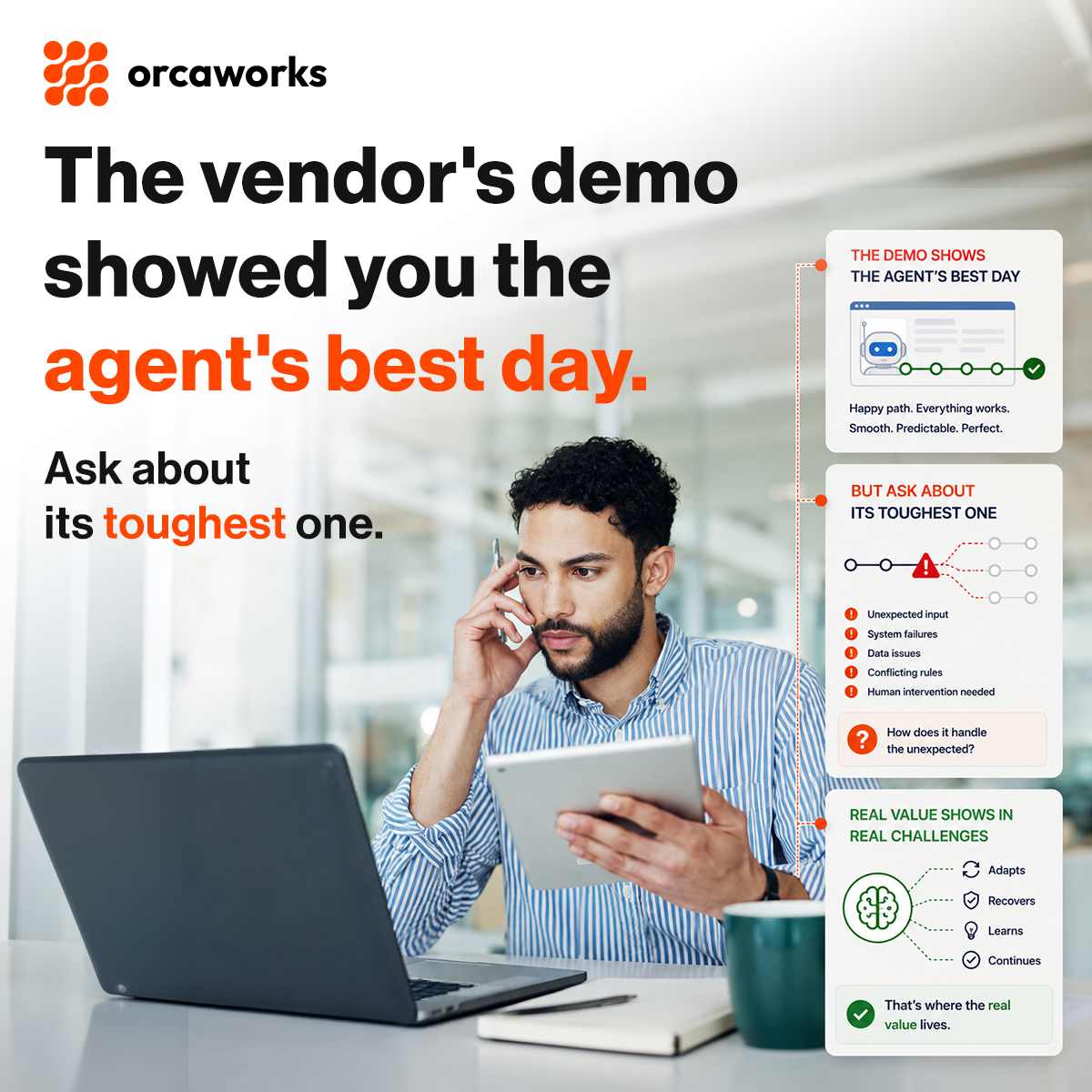
Most vendor demos look identical. An agent reads a document, takes an action, and the room nods. What that demo can’t show you is whether the platform behind it will still be trustworthy six months into production, once real data, real exceptions, and real compliance reviews enter the picture.
Knowing how to choose an agentic AI platform means asking questions the demo was never designed to answer. It means pushing past the polished scenario a sales team has rehearsed and asking what happens when something doesn’t go as planned, because in production, something always eventually doesn’t.
This checklist is built around the ten questions that matter most, and it follows directly from our broader breakdown of what an agentic AI platform is, which is worth reading first if you’re still early in evaluation.
Procurement and IT teams comparing vendors in this category are often looking at platforms that appear functionally similar on the surface but differ enormously underneath, in how they handle governance, exceptions, and long-term ownership. The questions below are meant to expose those differences before a contract gets signed, not after.
How to Choose an Agentic AI Platform: What This Checklist Covers
Choosing an agentic AI platform correctly means evaluating governance, integration depth, and production-readiness together, rather than treating them as three separate conversations that happen at different stages of procurement.
This agentic AI platform checklist walks through ten questions in a deliberate order: how a platform enforces rules, how it fits into systems you already run, and what happens after go-live. That sequence matters because each layer depends on the one before it. A platform with strong governance but poor integration still creates adoption friction. A platform with easy integration but weak auditability creates risk that surfaces later, usually at the worst possible time, during a compliance review or a post-incident investigation.
Question 1: Can You See Every Rule an Agent Follows Before It Runs?
A production-ready platform should let you inspect the exact logic governing an agent’s behavior before it ever touches live data. Not after something goes wrong, and not by request during an escalation, but as a standard part of how the platform operates day to day.
If a vendor’s answer to this question involves reading through prompt history or chat logs rather than pointing to a defined, versioned rule set, that’s a meaningful signal. It usually means the platform wasn’t built with pre-deployment review in mind, which becomes a real problem the moment your security or compliance team asks to see exactly what an agent is permitted to do.
Ask specifically whether business rules exist as reviewable, versioned artifacts your team can sign off on before deployment, or whether that logic lives implicitly inside a model’s behavior, discoverable only through trial and observation. The difference between those two answers tells you almost everything about how the rest of the platform is likely to behave.
Question 2: How Are Permissions and Approvals Enforced, Not Just Documented?
There’s a meaningful difference between a platform that documents an approval policy in a settings page and one that structurally enforces it in how agents operate. A written policy is a description. Structural enforcement is a guarantee.
Ask what happens, concretely, when an agent’s proposed action requires human sign-off. Does the system halt execution and route the decision to the right person automatically? Or does it depend on the agent recognizing, in the moment, that this particular action needs approval, and choosing to ask?
A platform worth choosing enforces this at the architecture level, so a missed approval isn’t just discouraged by policy, it’s structurally not possible. This distinction matters most in exactly the scenarios where it’s easiest to overlook, high-volume, routine-looking workflows where one exception slipping through unnoticed can cause real damage before anyone catches it.
Question 3: Can Decisions Be Reproduced and Audited Months Later?
Ask a vendor to walk through, step by step, what it takes to reconstruct exactly why an agent made a specific decision six months after the fact. Not a general description of “we log everything,” but the actual process someone on your team would follow.
When it comes to how to choose an agentic AI platform, if the answer involves digging through logs that weren’t designed for this specific purpose, correlating timestamps across multiple systems, or reconstructing context from scattered records, that’s a real limitation for any regulated or high-stakes use case. Full auditability isn’t something you can retrofit after a compliance team asks the hard question. It has to be built into the platform from the start.
Orcaworks Enterprise AI Safety Handbook covers what genuine decision traceability requires at the architecture level, which is a useful benchmark to hold any vendor’s answer against, including ours.
Question 4: Does It Work Inside Your Existing Systems, or Require New Ones?
A platform that requires teams to abandon their CRM, ERP, or ticketing system in favor of a new interface adds adoption risk that often outweighs whatever automation gain it promises. The cost of a new system isn’t just licensing. It’s retraining, workflow disruption, and the slow adoption curve that comes with asking people to change how they work.
Ask how deeply the platform integrates with systems already in daily use across your organization. A few specific questions help here:
Does it connect natively to your existing CRM, ERP, and document systems, or does it require custom middleware?
Can teams keep working inside the tools they already know, with the agentic layer working underneath?
How much workflow change is genuinely required to get value from it, versus what the sales deck implies?
The best answer is usually the least dramatic one: the platform disappears into your existing tools rather than asking your teams to learn a new one.
Question 5: How Does It Handle Unstructured Input and Exceptions?
Most real enterprise work is messier than a clean demo dataset. Documents arrive incomplete. Instructions contradict earlier ones. Fields that are supposed to be filled in are sometimes just missing.
Ask a vendor to show, not describe, how the platform handles a genuinely ambiguous input in real time. A description of “handles exceptions gracefully” is marketing language. Watching what happens when you feed it a deliberately messy input tells you far more.
How exceptions get surfaced, and where they get routed, says more about production readiness than almost any other single capability on this list. A platform that reasons through an exception and routes it with context to the right person is fundamentally different from one that simply halts and waits.
Question 6: Is This an Agentic AI Platform, or Just a Conversational AI Platform in Disguise?
This distinction trips up more buyers than any other question here, largely because the marketing language across both categories has converged. Conversational AI platforms are built primarily for customer or employee-facing chat and voice interactions: answering questions, routing tickets, holding a dialogue. Their core job is communication.
Agentic AI platforms are built for autonomous, multi-step execution across business processes, coordinating agents, tools, and approvals toward an outcome, with or without a conversational interface involved at all. Their core job is getting work done, not holding a conversation about it.
Some vendors market conversational tools with agentic language layered on top, since “agentic” has become a popular label regardless of what’s happening underneath. Ask directly: does this platform execute multi-step business processes end to end, or does it primarily manage dialogue and hand off the actual work to something else? Our detailed comparison of agentic AI vs AI agents vs RPA goes deeper into this category confusion and how to spot it before it costs you a procurement cycle.
Question 7: Is There an Established Analyst Framework for This Category Yet?
It’s worth asking a vendor this directly, since the honest answer matters more than a confident one. As of now, Gartner’s Magic Quadrant covers enterprise conversational AI platforms specifically, evaluating vendors on customer and employee-facing conversational capabilities, including how well they’ve incorporated agentic AI features into that conversational layer.
A dedicated Magic Quadrant for agentic AI platforms built around autonomous process execution, distinct from conversational AI, has not yet been established as its own category. That’s not a red flag. It reflects how new and fast-moving this space still is, and analyst frameworks typically take time to catch up to a genuinely new category of software.
What it does mean, practically, is that buyer diligence on governance, auditability, and integration depth currently matters more than analyst positioning. If a vendor claims placement in an analyst report specifically for “agentic AI platforms” as a standalone category, that claim is worth double-checking against what the report evaluates.
Question 8: How Does It Handle Multi-Agent Coordination, Not Just Single Tasks?
A platform that handles one agent performing one task well isn’t automatically equipped to coordinate multiple agents across a longer, interdependent process. Single-task competence and multi-agent orchestration are genuinely different engineering problems, and a vendor strong in one isn’t guaranteed to be strong in the other.
Ask specifically how the platform manages handoffs between agents. A few things worth probing:
What happens if one step in a multi-step sequence fails partway through?
How are conflicts between two agents working on related tasks resolved?
Is there a coordination layer, or does each agent operate independently with no shared awareness of the broader process?
Orcaworks’ approach to agentic process automation is a useful reference point for what this looks like when it’s built for genuine multi-step orchestration, rather than several single-task automations strung together after the fact and presented as one workflow.
Question 9: What Does Onboarding and Time-to-Production Look Like?
Ask for a realistic, specific timeline from contract signature to a live, governed workflow running in production, not a demo environment and not a proof-of-concept sandbox. The gap between those two things is where a lot of agentic AI initiatives quietly stall.
Vendors with strong underlying architecture but thin implementation support can leave teams stuck in a long, undefined “pilot” phase that never quite graduates to real production use. That’s often not a technology failure. It’s an onboarding failure, and it’s worth evaluating separately from the platform’s technical capabilities.
A platform built for genuine enterprise adoption should have a clear, structured onboarding path with defined milestones, not an open-ended engagement where “we’re still configuring things” becomes the answer every time you check in.
Question 10: Who Owns This Internally Once It’s Live?
While wondering how to choose an agentic AI platform, this is one question buyers skip most often, and it’s usually the one that determines whether an initiative survives past its first year. Everyone plans for the launch. Fewer people plan for who’s responsible six months later when a rule needs updating or an exception pattern needs a new resolution path.
Ask who on your team will own rule updates, exception handling, and ongoing governance once the platform is running day to day. Then ask whether the vendor provides the actual tools to make that ownership realistic, or whether it quietly requires a dedicated engineering team just to keep the system maintained.
The honest answer to this question often separates platforms built for internal teams to run independently from platforms that create long-term dependency on the vendor for anything beyond the basics.
Putting the Agentic AI Platform Checklist Together
| Question | What “Good” Looks Like | Red Flag |
|---|---|---|
| Visibility into agent rules | Versioned, reviewable rule sets | Logic buried in prompt history |
| Approval enforcement | Structural routing, not optional | Relies on the agent remembering to ask |
| Decision reproducibility | Full audit trail, reconstructable | Logs not built for post-hoc review |
| System integration | Works inside existing tools | Requires replacing core systems |
| Exception handling | Reasoned, routed, resolved | Manual stop with no context |
| Category clarity | Executes multi-step processes | Conversational tool rebranded as agentic |
| Analyst framework maturity | Transparent about category gaps | Overstates analyst recognition |
| Multi-agent coordination | Defined handoffs and failure handling | Single-task automation only |
| Time-to-production | Clear, structured onboarding | Open-ended “pilot” phase |
| Internal ownership | Realistic tools for your team to own it | Dependent on vendor indefinitely |
Choosing an Agentic AI Platform Built for Production, Not Just a Pilot
Every question on this list points at the same underlying test: does this platform hold up once it’s carrying real decisions, not just answering well in a sales conversation. Knowing how to choose an agentic AI platform means treating governance, integration, and internal ownership as equally important as raw capability, since capability alone is what every vendor will show you first, and it’s rarely what determines whether an initiative is still running successfully a year later.
“The platforms that fail enterprises aren’t the ones with weaker models,” says Dr. Abhinav Somaraju, co-founder of Orcaworks. “They’re the ones that can’t reconstruct a decision six months later, or tell you who owns the system once it’s live. That’s usually where the real gaps are, and it’s rarely the thing a demo was built to show you.”
If you’re evaluating platforms against this checklist and want a second opinion on where a vendor’s answers hold up under pressure, that’s a conversation worth having directly, before a contract locks you into finding out the hard way.
Frequently Asked Questions
1. What is an agentic AI platform?
An agentic AI platform is infrastructure that lets enterprises define, govern, and execute multi-step business processes through coordinated AI agents, rather than a single agent handling one isolated task or a conversational tool managing dialogue.
2. How is an agentic AI platform different from a conversational AI platform?
Conversational AI platforms are built primarily for customer or employee-facing chat and voice interactions. Agentic AI platforms are built for autonomous, multi-step execution across business processes, coordinating agents and approvals toward an outcome, with or without a conversational interface involved at all.
3. How do I choose an agentic AI platform for my organization?
Choosing an agentic AI platform means evaluating governance, system integration, and production-readiness together. Key questions include whether agent rules are reviewable before deployment, whether approvals are structurally enforced, and whether decisions can be reproduced and audited months later.
4. What should be on an agentic AI platform checklist?
A solid checklist covers visibility into agent rules, approval enforcement, decision auditability, integration with existing systems, exception handling, category clarity between conversational and agentic AI, multi-agent coordination, onboarding timelines, and internal ownership after go-live.
5. Is there a Gartner Magic Quadrant for agentic AI platforms?
Not yet as a standalone category. Gartner’s Magic Quadrant currently covers enterprise conversational AI platforms, which evaluates vendors on customer and employee-facing conversational capabilities, including how well they’ve incorporated agentic AI features into that layer. A dedicated framework for autonomous process-execution platforms has not yet been established separately.
6. What’s the difference between a single AI agent and full agentic orchestration?
A single AI agent typically handles one bounded task using reasoning and context. Full agentic orchestration coordinates multiple agents across an entire process, managing handoffs, exceptions, and approvals as a sequence rather than a standalone action.
7. Why does audit trail depth matter when evaluating an agentic AI platform?
Because compliance and security reviews happen after deployment, often months later. A platform that can’t reconstruct exactly why an agent made a specific decision creates real risk in regulated or high-stakes use cases, regardless of how capable the underlying model is.
8. How long does it typically take to move an agentic AI platform from pilot to production?
This varies significantly by vendor, which is exactly why it’s worth asking for a specific, realistic timeline rather than a general estimate. Platforms with strong architecture but thin implementation support can leave teams stuck in an undefined pilot phase far longer than expected.
9. Who should own an agentic AI platform internally after it goes live?
Ownership typically falls to a combination of IT, compliance, and the business unit closest to the process being automated. The right platform provides tools that make this ownership realistic without requiring a dedicated engineering team just for maintenance.
10. What’s the biggest mistake enterprises make when evaluating agentic AI platforms?
Judging platforms primarily on how impressive a scripted demo looks, rather than probing governance, auditability, and long-term ownership. The platforms that struggle in production are rarely the ones with weaker models, they’re the ones that couldn’t answer the harder operational questions clearly.