
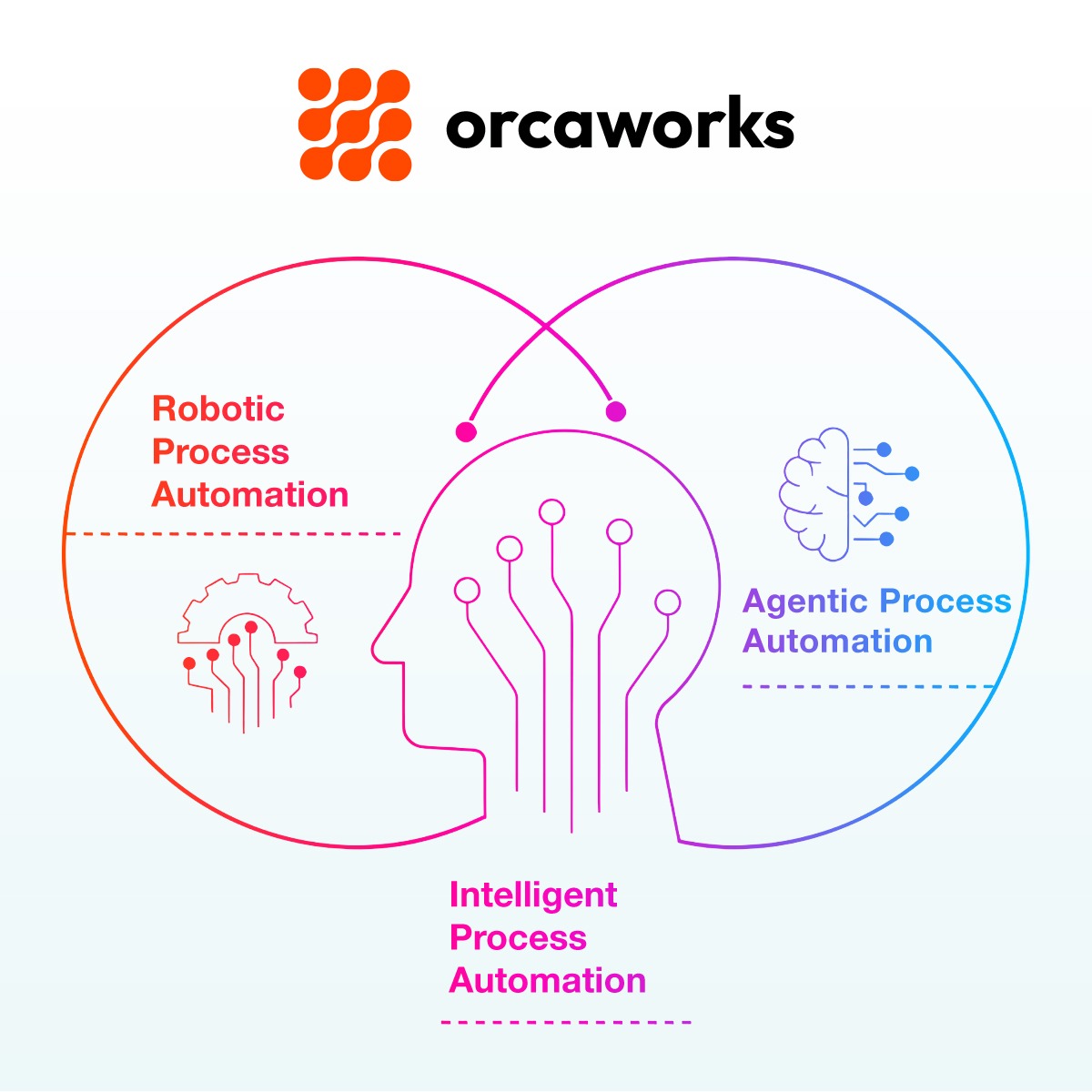
Initially organizations began with Robotic Process Automation to reduce manual effort, then explored Intelligent Process Automation to incorporate AI models into workflows. Now a new paradigm is emerging: Agentic Process Automation, where autonomous AI agents execute goals rather than scripted tasks.
The terminology sounds similar, yet the architectural implications are radically different. Selecting the wrong automation model can stall transformation initiatives, inflate operational complexity, and limit AI scalability. Which is why this guide clarifies RPA vs IPA vs APA so enterprise leaders can make architecture decisions aligned with long term AI strategy with confidence.
What Is Robotic Process Automation (RPA)?
Definition and Core Functionality
Robotic Process Automation refers to software bots that replicate structured, rule-based human actions within digital systems. These bots operate through predefined logic, interacting with applications at the user interface level or through APIs. RPA is deterministic. It executes what it is programmed to execute, without learning or adapting beyond those instructions.
RPA excels in environments where workflows are repetitive, standardized, and dependent on structured data. Examples include invoice processing, claims validation, payroll updates, report generation, and data reconciliation across enterprise systems.
Is RPA Considered AI?
RPA is often confused with artificial intelligence, but it is not inherently AI-driven automation. Traditional RPA lacks reasoning, contextual awareness, and learning capability. It does not interpret ambiguous inputs or make probabilistic decisions. It automates tasks, not judgments.
This distinction matters when enterprises attempt to scale automation into areas involving unstructured data such as emails, contracts, or customer conversations. Pure RPA struggles in those environments because it cannot interpret intent or extract meaning without additional AI layers.
Enterprise Benefits of RPA
RPA delivers rapid ROI in high-volume back-office operations. It reduces manual errors, improves compliance through consistent execution, and accelerates processing cycles. Organizations often adopt RPA as an entry point into enterprise automation because deployment can be relatively fast and low risk.
Where RPA Breaks Down
At scale, limitations become visible. RPA bots require continuous maintenance when underlying systems change. They lack decision intelligence, making them fragile in dynamic environments. Complex orchestration across departments becomes difficult because bots execute tasks, not outcomes.
For enterprises pursuing enterprise AI transformation, RPA represents the first phase of automation maturity. It improves operational efficiency but does not fundamentally redesign how decisions are made or how work is orchestrated across the organization.
What Is Intelligent Process Automation (IPA)?
How IPA Extends RPA with Artificial Intelligence
Intelligent Process Automation builds on Robotic Process Automation by integrating artificial intelligence technologies such as machine learning, natural language processing, computer vision, and predictive analytics into automated workflows. While RPA executes predefined rules, IPA introduces systems that can interpret unstructured data, recognize patterns, and support decision-making processes.
IPA enables automation across documents, emails, chat interactions, voice transcripts, and semi-structured enterprise data. Instead of simply moving data between systems, it can classify incoming requests, extract relevant information from contracts, detect anomalies in financial transactions, and trigger downstream workflows based on probabilistic models.
Is IPA the Same as AI Automation?
IPA is often described as AI-driven automation, but it is more accurately understood as a hybrid architecture. It typically combines rule-based bots with AI components layered into specific process steps. The RPA layer handles deterministic execution, while AI services provide interpretation, prediction, or classification.
For example, in insurance claims processing, an IPA system may use machine learning to assess claim risk and natural language processing to interpret customer narratives, then rely on RPA to update policy systems. The intelligence is modular rather than autonomous.
Enterprise Use Cases and Architectural Implications
Intelligent Process Automation is widely adopted in banking, healthcare, supply chain, and customer service environments where unstructured data is unavoidable. It improves decision support, enhances customer experience, and reduces manual review workloads.
However, IPA introduces architectural complexity. AI models require training data, monitoring, governance controls, and lifecycle management. Integration between bots and AI services can become fragmented if not designed strategically. Enterprises often discover that IPA improves processes incrementally but still relies heavily on predefined workflows, limiting adaptability in rapidly changing environments.
As organizations pursue scalable enterprise automation, IPA represents a significant step forward from traditional RPA, yet it still centers on process optimization rather than autonomous goal execution.
What Is Agentic Process Automation (APA)?
Moving from Task Automation to Goal-Oriented Automation
Agentic Process Automation represents the next evolution in enterprise AI automation. Instead of automating individual tasks or embedding intelligence into isolated workflow steps, APA introduces autonomous AI agents capable of reasoning, planning, and executing toward defined business objectives.
Agentic AI systems operate with contextual awareness. They can evaluate dynamic inputs, determine the next best action, orchestrate multiple systems, and adapt their execution path without rigid scripting. This shifts automation from deterministic execution to outcome-driven orchestration.
How APA Differs from IPA
The key difference between IPA and APA lies in autonomy and orchestration. IPA augments processes with intelligence but still depends on predefined flows. APA deploys AI agents that interpret goals, break them into sub-tasks, coordinate across applications, and adjust strategies in real time.
For instance, in enterprise procurement, an APA system could evaluate vendor performance, negotiate within predefined thresholds, reroute orders during supply disruptions, and update financial systems automatically. The agent acts with bounded autonomy aligned to governance policies rather than executing static scripts.
Enterprise AI Agents and Scalable Architecture
Agentic Process Automation enables the concept of enterprise AI agents or digital coworkers. These agents integrate with APIs, enterprise applications, knowledge bases, and data platforms. They reason across structured and unstructured data while maintaining compliance controls and auditability.
This model supports adaptive automation at scale. Complex cross-functional workflows such as revenue operations, IT incident management, and customer lifecycle orchestration can be managed through coordinated AI agents rather than isolated bots.
For enterprise leaders evaluating RPA vs IPA vs APA, Agentic Process Automation introduces a fundamentally different architecture. It positions automation not as a productivity tool, but as an intelligent execution layer embedded within enterprise strategy.
RPA vs IPA vs APA: Key Differences in Automation Architecture
If you’re evaluating RPA vs IPA vs APA, you must look beyond surface-level capability and examine architectural depth, scalability, governance, and long-term AI alignment. Each model reflects a different stage of automation maturity, and selecting the wrong one can create technical debt or stall enterprise AI initiatives.
Intelligence and Decision Capability
RPA operates on fixed rules and structured inputs. It executes deterministic tasks without contextual understanding. IPA introduces AI components that classify, predict, and interpret, but these capabilities are typically embedded within predefined workflows. APA shifts the paradigm entirely, enabling AI agents to reason, plan, and adapt based on goals and environmental inputs.
In practical terms, RPA handles tasks. IPA enhances processes. APA orchestrates outcomes.
Data Handling and Complexity
RPA works best with structured data sourced from ERP systems, CRM platforms, or databases. It struggles with variability. IPA expands automation into unstructured domains such as emails, documents, and chat conversations using machine learning and natural language processing. APA handles both structured and unstructured data while maintaining context across multiple systems and interactions.
This distinction becomes critical in complex enterprise environments where decisions span departments and require continuous interpretation rather than static routing.
Orchestration and Scalability
RPA bots typically operate within narrow process boundaries. Scaling often requires duplicating bots, increasing maintenance overhead when applications change. IPA improves scalability by integrating AI services, yet orchestration logic remains largely workflow-driven.
APA introduces coordinated AI agents that can operate across business units, systems, and data layers. Agents interpret objectives, decompose them into tasks, and collaborate when necessary. This architecture reduces brittle dependencies and supports enterprise-wide automation strategy rather than isolated departmental efficiency gains.
Governance and Enterprise Readiness
Governance complexity increases as intelligence increases. RPA requires monitoring for bot failures and application changes. IPA demands model governance, bias monitoring, retraining cycles, and explainability controls. APA adds autonomous decision oversight, policy constraints, and auditability frameworks.
Organizations pursuing enterprise AI transformation must evaluate whether their automation architecture supports observability, compliance, and controlled autonomy. The shift from RPA to APA is not merely technological. It is architectural and strategic.
When Should Enterprises Use RPA vs IPA vs APA?
Selecting the right automation model depends on operational maturity, data complexity, and long-term AI ambition. Not every enterprise requires agentic automation immediately, yet remaining at the RPA stage indefinitely can limit competitive advantage.
Use RPA for Structured, High-Volume Tasks
RPA remains highly effective for repetitive back-office processes involving stable systems and rule-based decisions. Finance reconciliation, HR onboarding workflows, data migration, and report consolidation often benefit from rapid bot deployment. Organizations seeking quick efficiency gains without large AI investments can still achieve meaningful ROI at this level.
However, enterprises should avoid treating RPA as a long-term automation architecture. Its rigidity makes it vulnerable in dynamic environments.
Use IPA for Process Enhancement and Cognitive Support
Intelligent Process Automation is suitable when workflows involve unstructured data and probabilistic decisions. Customer service triage, fraud detection, underwriting support, and document-heavy operations benefit from embedded AI models.
IPA works well when enterprises want to augment human decision-makers while maintaining structured control over workflows. It provides measurable performance improvements but still operates within predefined process boundaries.
Use APA for Strategic, Cross-Functional Automation
Agentic Process Automation is appropriate when enterprises seek adaptive, outcome-driven automation across systems and departments. Revenue operations, supply chain optimization, IT operations management, and enterprise-wide service orchestration require more than incremental intelligence.
APA aligns with organizations building AI-native operating models. It enables AI agents to function as digital coworkers that interpret goals, coordinate tasks, and adjust execution dynamically within governance constraints.
A Practical Enterprise Decision Framework
Enterprises should assess automation readiness across four dimensions: data maturity, integration depth, governance capability, and strategic AI objectives. Organizations with siloed systems and limited AI governance may begin with RPA or IPA while building foundations. Enterprises pursuing competitive differentiation through AI should evaluate agentic architectures sooner rather than later.
The transition from RPA to IPA to APA reflects increasing autonomy and strategic impact. Choosing the right automation architecture is not about following trends. It is about aligning automation capability with enterprise ambition.
Is RPA Becoming Obsolete?
Robotic Process Automation is not obsolete, but it is frequently misapplied. Many enterprises expected RPA to deliver enterprise-wide transformation when it was designed primarily for task automation. When deployed without architectural foresight, bot sprawl, maintenance overhead, and fragile workflows create diminishing returns.
RPA continues to generate value in stable, rules-based environments with structured data and predictable workflows. Finance operations, compliance reporting, and transactional processing remain strong candidates. The issue is not the technology itself, but the expectation that task automation alone can drive intelligent enterprise execution.
Organizations that treat RPA as a foundation rather than a destination can extend its value through integration with AI services or agentic orchestration layers. Enterprises that remain confined to isolated bots risk stagnation as competitors move toward adaptive, AI-driven automation architectures.
What Does Automation Architecture Look Like in 2026 and Beyond?
The future of enterprise automation is increasingly agentic, composable, and deeply integrated with enterprise AI strategy. Copilot-style assistants are evolving into autonomous agents capable of reasoning across systems, data platforms, and business functions. Automation is shifting from workflow scripting to outcome orchestration.
Enterprise architectures are moving toward modular AI services, API-first integration, real-time observability, and policy-driven governance. Human employees and AI agents operate within the same execution environment, with clear accountability and transparent decision boundaries.
Organizations that design automation architecture with autonomy, governance, and scalability in mind will be positioned to compete in an AI-native economy. The question is no longer whether to automate, but how intelligently that automation can think, adapt, and execute.
From Automation to Autonomous Enterprise
Automation Maturity Is Now a Strategic Decision
The evolution from RPA to IPA to APA is not simply a progression of tools. It reflects a fundamental shift in how enterprises approach enterprise automation, artificial intelligence, and digital transformation strategy. Task automation improves efficiency. Intelligent automation enhances processes with machine learning and AI models. Agentic Process Automation reshapes how work is executed across the enterprise through autonomous AI agents.
As organizations evaluate RPA vs IPA vs APA, the real differentiator is no longer feature depth. It is architectural vision. Enterprises need an automation architecture that supports autonomous decision-making, cross-system orchestration, enterprise-grade governance, observability, and long-term scalability. Many traditional RPA and IPA platforms automate workflows effectively but struggle to deliver adaptive, outcome-driven enterprise AI execution.
Why Agentic Architecture Changes the Game
Modern enterprises operate in environments defined by data complexity, system fragmentation, and constant change. Static workflows and isolated bots cannot keep pace. Autonomous enterprise automation requires systems that interpret goals, coordinate across applications, and adapt execution paths dynamically while maintaining compliance and auditability.
Agentic AI introduces this capability. Instead of scripting every possible scenario, organizations define business objectives and governance boundaries. AI agents then reason, plan, and execute within those constraints. This transition from task execution to goal orchestration marks the true shift toward an AI-native operating model.
How Orcaworks Enables Enterprise Agentic Automation
Orcaworks is designed specifically for this next generation of automation. As an enterprise-grade agentic AI platform, Orcaworks enables organizations to build, deploy, and manage AI agents that function as digital coworkers across business functions. These agents operate across structured and unstructured data, integrate with enterprise systems, and execute cross-functional workflows aligned with defined business outcomes.
Unlike conventional automation platforms that rely heavily on rigid process flows, Orcaworks supports adaptive automation architecture. It provides governance controls, orchestration layers, and enterprise integration capabilities that allow Agentic Process Automation to scale responsibly. Enterprises can unify RPA, IPA, and AI services within a coordinated agentic framework rather than managing disconnected automation initiatives.
This approach transforms automation from incremental efficiency gains into strategic execution capability. Revenue operations, IT service management, compliance workflows, supply chain coordination, and customer lifecycle orchestration can be managed through intelligent agents operating within a controlled enterprise environment.
The Next Step Toward Autonomous Enterprise Execution
The shift from process automation to autonomous enterprise execution is already underway. Organizations that design their automation architecture around intelligence, adaptability, and governance will lead in an AI-driven economy.
If your enterprise is evaluating RPA vs IPA vs APA and preparing for large-scale AI automation, Orcaworks provides the foundation to move beyond isolated bots and fragmented AI integrations toward true Agentic Process Automation.
Explore how Orcaworks can power your enterprise automation strategy and accelerate your AI transformation journey.
Frequently Asked Questions
What is the main difference between RPA, IPA, and APA?
The primary difference lies in intelligence and autonomy. Robotic Process Automation executes predefined, rule-based tasks using structured data. Intelligent Process Automation combines RPA with artificial intelligence technologies such as machine learning and natural language processing to interpret unstructured data and support decision-making. Agentic Process Automation introduces autonomous AI agents that reason, plan, and execute toward defined business goals with contextual awareness and adaptive orchestration.
Is IPA the same as AI automation?
Intelligent Process Automation is a form of AI-driven automation, but it is not fully autonomous. IPA embeds AI models into structured workflows, allowing systems to classify, predict, and interpret data. However, execution paths are still largely predefined. True autonomous enterprise automation emerges in agentic architectures where AI agents determine next steps dynamically within governance constraints.
Does APA replace RPA and IPA?
Agentic Process Automation does not eliminate RPA or IPA. Instead, it can orchestrate and coordinate them. Many enterprises continue using RPA for stable transactional processes and IPA for cognitive enhancements while layering agentic AI agents on top to manage cross-functional goals. The models can coexist within a unified automation architecture.
When should a company move beyond RPA?
Organizations should consider moving beyond RPA when processes involve unstructured data, frequent change, cross-department coordination, or complex decision logic. If bot maintenance costs are rising or automation initiatives are failing to scale, it may signal that a more intelligent or agentic architecture is required.
What industries benefit most from Agentic Process Automation?
Industries with complex, dynamic operations benefit significantly from agentic automation. Financial services, healthcare, retail, manufacturing, logistics, and technology enterprises often require adaptive decision-making across systems. Agentic AI agents can optimize revenue operations, supply chain management, compliance workflows, and customer lifecycle orchestration.
Is RPA considered artificial intelligence?
Traditional RPA is not considered artificial intelligence. It follows deterministic rules without learning or contextual reasoning. AI capabilities can be integrated into RPA-driven environments, but the core RPA technology itself does not possess intelligence.
What is the ROI of enterprise automation platforms?
Return on investment varies based on scope and architecture. RPA often delivers rapid short-term cost savings through labor reduction and efficiency gains. IPA improves quality and decision accuracy, leading to reduced error rates and improved customer satisfaction. APA can drive strategic ROI by accelerating cycle times, improving cross-functional coordination, and enabling AI-native operating models that generate competitive advantage.
How do AI agents improve business process automation?
AI agents enhance business process automation by operating with contextual awareness and goal alignment. They can interpret changing inputs, coordinate across systems, determine next best actions, and adapt workflows dynamically. This reduces reliance on rigid scripts and enables automation to function as an intelligent execution layer rather than a static task engine.